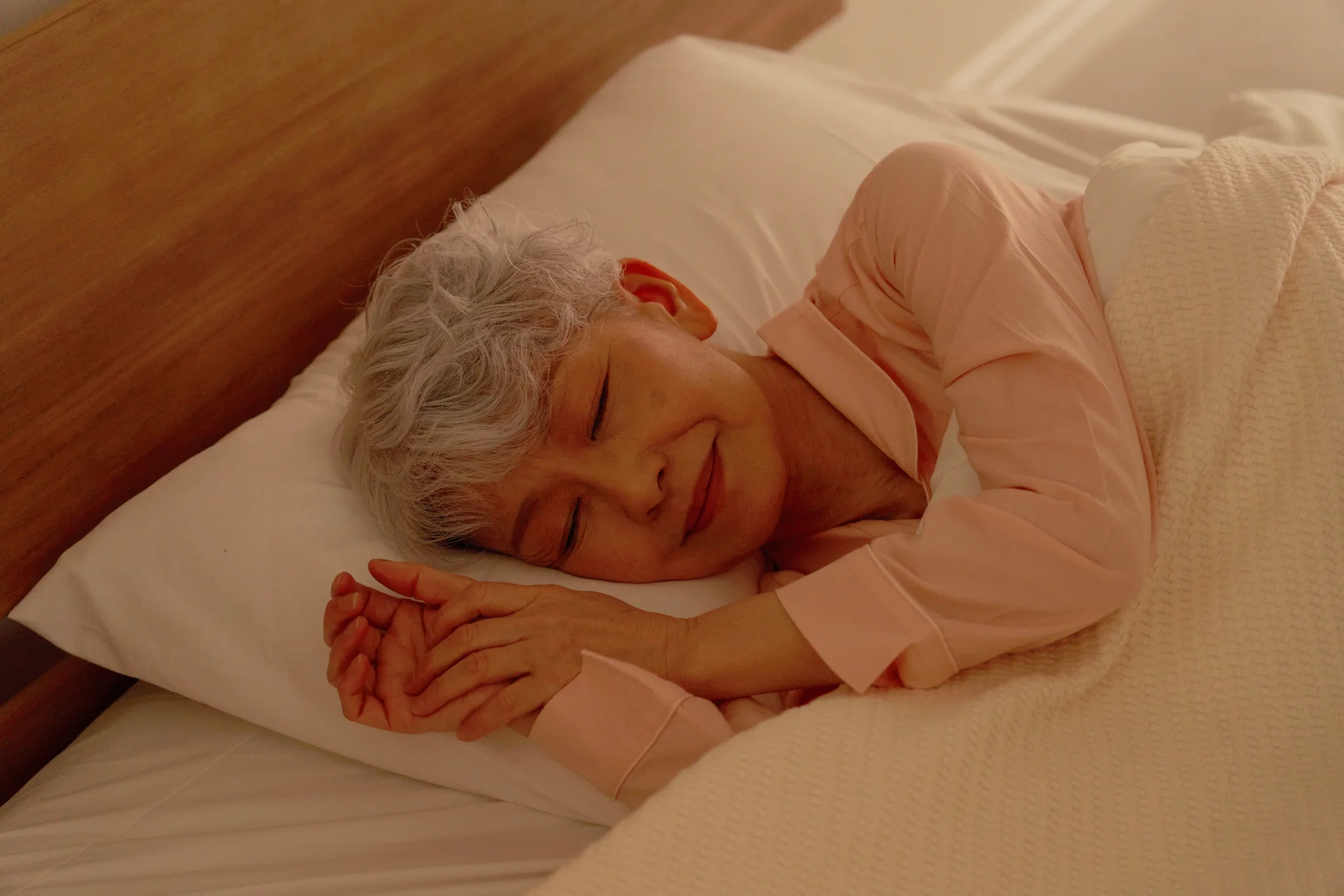
Protea would like to help you understand what an older body needs during sleep, and how to make every night a genuinely restful one.
Why Sleep Quality Matters So Much for Seniors
Ohayon et al. (2017), from the National Sleep Foundation, found that older adults should get 7–8 hours of sleep per night — with good sleep quality, not just quantity. Deep sleep helps the body repair itself, strengthens the immune system, and preserves memory. Repeated poor sleep leads to a higher risk of falls, high blood pressure, and a weakened immune system.
The Best Sleeping Positions for Seniors
In general, the side-lying position is the most recommended for older adults, because it keeps the airway open, reduces snoring, and reduces pressure on the spine. But it has to be done correctly — and that’s where Protea’s positioning pillows can help.
- A pillow under the head: the right height to keep the neck straight — not bent too far up or down.
- A pillow between the knees: helps maintain hip alignment and reduces pressure on the knee joints.
- A pillow behind the back: helps keep the body from rolling backward.
Ghazali et al. (2022) studied the use of positioning bedding in bedridden patients and found that a 30-degree side-lying position significantly reduces pressure on the buttocks and hips compared with lying flat on the back.
The Turning Schedule Every Caregiver Should Know
For older adults who can barely move on their own, Gillespie et al. (2020) recommend changing position every 2 hours to prevent pressure sores. A simple schedule, for example:
- 10:00 PM — Left side-lying
- 12:00 AM — On the back
- 2:00 AM — Right side-lying
- 4:00 AM — On the back
- 6:00 AM — Left side-lying
Having a clear schedule helps both caregiver and patient know what to expect — it reduces startle and makes turning smoother.
How the Protea Positioning Pillow Helps
The Protea Positioning Pillow is made from high-density foam with angles designed to fit the body for various sleeping positions. It is designed to hold the correct side-lying position without needing several pillows, helps prevent the body from leaning backward, and keeps the spine aligned all night. It can also be placed under the knees to reduce the arch of the spine when lying on the back, and under the ankles to encourage blood flow back toward the heart and reduce swollen feet.
For caregivers, the benefit is fewer midnight trips to reposition the patient — so both of you can sleep more continuously and rest more deeply.

Extra Tips for a Restful Night
- The bedroom should be cool — 22–24°C is ideal.
- Turn off the lights and reduce noise, because light disrupts melatonin release.
- Don’t drink large amounts of fluid before bed, to reduce nighttime trips to the bathroom.
- Take a warm bath 1–2 hours before bed: it lowers body temperature and triggers sleepiness.
Protea hopes that tonight, and every night after, the seniors in your home get true rest — because good sleep isn’t a luxury; it’s the foundation of good health at every age.
References
- Ohayon, M.M. et al. (2017). National Sleep Foundation’s sleep quality recommendations: first report. Sleep Health, 3(1), 6–19. https://pubmed.ncbi.nlm.nih.gov/28346153/
- Gillespie, B.M. et al. (2020). Repositioning for pressure injury prevention in adults. Cochrane Database of Systematic Reviews, (6). https://pmc.ncbi.nlm.nih.gov/articles/PMC7265629/
- Ghazali, W.S.W. et al. (2022). Repositioning mattress: how a lateral tilt position reshapes the prevention of pressure ulcers in bedridden patients. Journal of Medical Engineering & Technology, 46(8). https://www.tandfonline.com/doi/abs/10.1080/03091902.2022.2094007